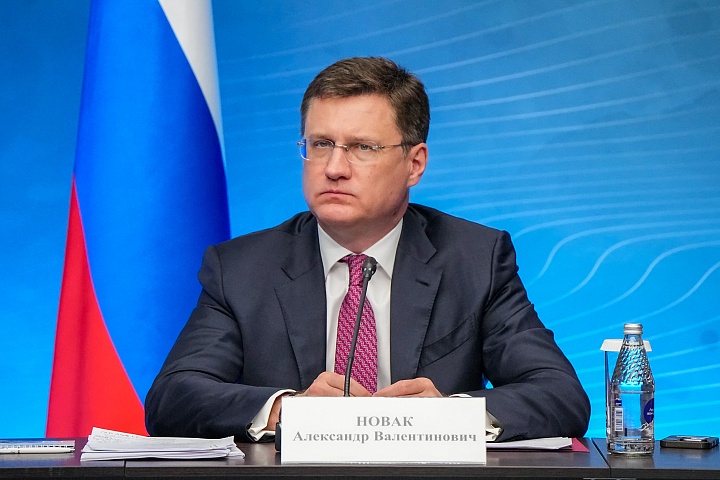

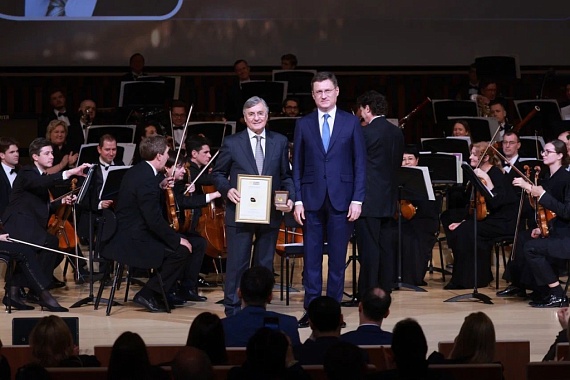
The award ceremony for the Global Energy Prize was held at the Zaryadye Concert Hall as part of the Gala Evening commemorating the launch of the Russian Energy Week, hosted by the Roscongress Foundation. This year’s recipients included Vladislav Khomich (Institute of Electrophysics and Electric Power, Russian Academy of Sciences, Russia), Jinliang He (Tsinghua University, China), and Yu Huang (University of California, Los Angeles, USA). Deputy Prime Minister of the Russian Federation Alexander Novak presented the Prizes to the laureates. The ceremony was conducted by Sergey Brilev, President of the Global Energy Association. Nobel Prize Laureate Rae Kwon Chung, Chairman of the International Global Energy Award Committee, attended as the guest of honour.
During his address to the ceremony’s participants and guests, Alexander Novak highlighted the award’s expanding international reach and emphasized the importance of a balanced strategy for shaping the energy of the future. He stated, “Over time, this award has become a model of effective global cooperation among government officials, industry leaders, and scientists. Since 2003, 56 researchers from 16 countries, including Australia, Austria, Great Britain, Greece, Denmark, Iceland, Italy, Canada, China, Russia, the USA, Ukraine, France, Switzerland, Sweden, and Japan, have been honoured. This year, the award’s independent International Committee selected three laureates representing the leading scientific superpowers—Russia, China, and the USA. Their breakthroughs address the modern energy sector’s need for innovation and responsibility in future energy development. Today, it is vital to advance new technologies while maintaining a sensible balance with conventional energy sources and to seek solutions that enhance the efficiency and environmental sustainability of the fuel and energy industry. I congratulate the laureates on their well-earned success.”
Rae Kwon Chung highlighted the crucial role of international scientific cooperation, which the Prize represents: “We live in an era where energy forms the foundation of sustainable development. It is particularly symbolic that this year’s laureates come from scientific institutions in Russia, China, and the United States, nations whose partnership significantly shapes the global science and technology agenda. The Global Energy Prize is not merely an award; it symbolizes international collaboration and our collective responsibility to future generations.”
All three laureates highlighted the significance of scientific collaboration in their speeches and urged colleagues worldwide to unite in tackling global energy challenges.
Professor Jinliang He of Tsinghua University, China, who was awarded in the Traditional Energy category for his work on ultra-high-voltage power transmission technology, stated: “I am deeply honoured to receive this award here in Moscow. This recognition belongs to my entire team at Tsinghua University and to all the researchers and engineers dedicated to enhancing protection against electromagnetic transients in ultra-high-voltage power transmission, as well as advancing environmentally friendly underground transmission technologies. I also sincerely thank my family and colleagues for their steadfast support and the entire international energy community for its inspiring cross-border cooperation. Together, through science and innovation, let us continue to brighten the world with clean and reliable energy.”
Professor Yu Huang of UCLA, the first female laureate in the award’s history, was honoured in the Non-traditional Energy category for her development of integrated nanomaterials that enhance the efficiency and reliability of fuel cells. In her video message, she also emphasized the need for collaboration:
“I sincerely thank the International Prize Committee for this recognition and the Association for its steadfast dedication to advancing global energy science. My team is focused on developing new catalysts and, more importantly, bridging the gap between discovery and practical application. We work on adapting new materials for energy conversion and storage. This effort demands curiosity, perseverance, and cooperation. I am fortunate to collaborate with a team of exceptional students, postdoctoral fellows, and co-authors whose creativity and passion drive our progress. This award belongs to all of us. Energy is a global challenge that cannot be solved without worldwide cooperation. Whether it’s decarbonization or ensuring equal access to energy, we must unite across national and scientific boundaries for the common good and for the benefit of future generations.”
Vladislav Khomich, Head of Research, Institute of Electrophysics and Electric Power at the Russian Academy of Sciences, and recipient of the award in the New Energy Applications category for his fundamental research in plasma technology and power optics, expressed gratitude to his colleagues: “The most important recognition for me is the international acknowledgment of the role and achievements of fundamental research carried out by scientists at the Russian Academy of Sciences in the energy field. I believe the Global Energy Prize strongly encourages the advancement of fundamental energy science and helps broaden its global partnerships. I extend my thanks to all my colleagues—scientists from the Institute of Electrophysics and Electric Power, members of the Department of Energy, Mechanical Engineering, Mechanics, and Control Processes, the leadership of the Russian Academy of Sciences, as well as my family, for their continuous support throughout my work.”
The evening ended with a performance by the Bolshoi Theatre Symphony Orchestra, celebrating its 250th season this year. Led by conductor Anton Grishanin, Honoured Artist of Russia, the orchestra played the overture from the opera Ruslan and Lyudmila by Mikhail Glinka, the Polovtsian Dances from the opera Prince Igor by Alexander Borodin, and the suite from Pyotr Tchaikovsky’s ballet The Nutcracker.
The Russian Energy Week is taking place in Moscow from 15 to 17 October. REW 2025 is supported by the Government of the Russian Federation, the Ministry of Energy of the Russian Federation, and the Government of Moscow, and is organized by the Roscongress Foundation.